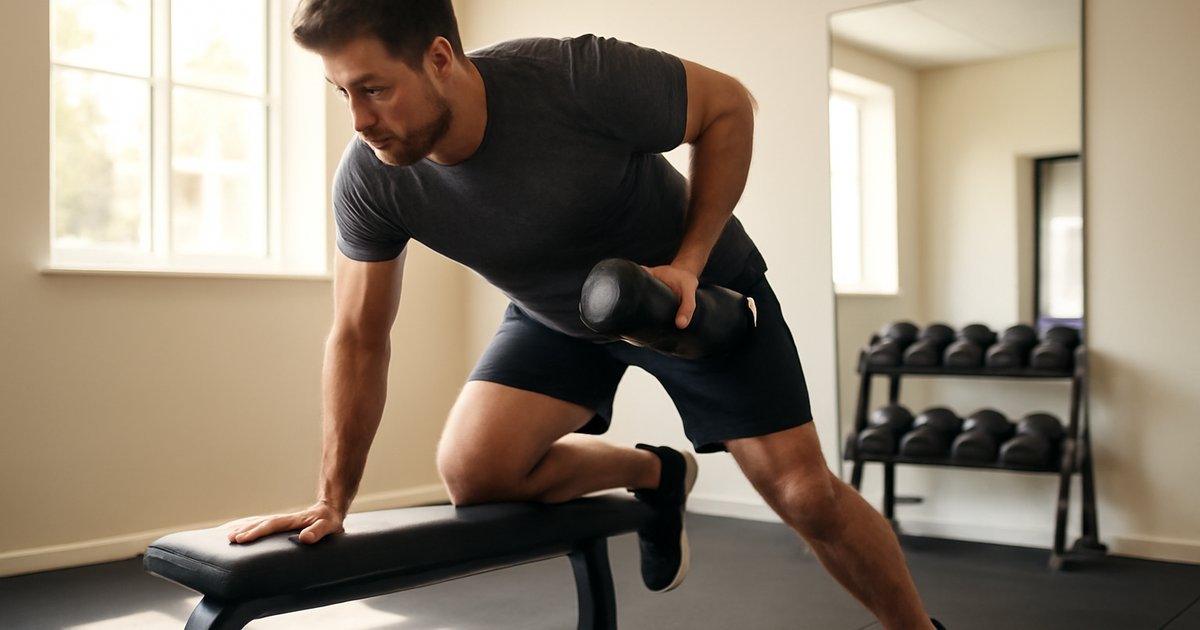
Dumbbell Training: The Complete Guide for Adults
You don't need a packed gym, a dozen machines, or a personal trainer on speed dial — a pair of dumbbells and the right plan can transform the way your body looks, moves, and feels.
Walk into any gym across America and you'll see the same pattern: the fancy cable machines sit empty half the time, while the dumbbell rack is almost always busy. There's a reason for that. Dumbbells are arguably the most versatile, accessible, and effective training tools ever created — and the science backs that up.
Whether you're training at home with a single pair of adjustable dumbbells or working your way through a full rack at the gym, dumbbell training delivers real, measurable results for adults across every fitness level. From building lean muscle and improving joint stability to supporting bone density and metabolic health, the benefits go far beyond what most people expect.
In this complete guide, you'll learn exactly how dumbbell training works, how to structure your workouts for your specific goals, which mistakes to avoid, and what realistic progress actually looks like. Whether you're just getting started or looking to sharpen your existing routine, this guide meets you where you are.
Why Dumbbell Training Matters More Than You Think
Most adults significantly underestimate how powerful a structured dumbbell routine can be. It's easy to assume that "real" training requires barbells, machines, or expensive equipment. That assumption leaves a lot of gains — and health benefits — on the table.
The American College of Sports Medicine (ACSM) recommends that adults engage in resistance training at least two to three days per week, targeting all major muscle groups. Dumbbells can meet that recommendation completely, and in many cases, they offer advantages over fixed machines because they require your stabilizing muscles to work simultaneously with your primary movers.
A study published in the Journal of Strength and Conditioning Research found that unilateral dumbbell exercises — movements performed one side at a time — activate significantly more core musculature than bilateral barbell exercises at comparable loads. That means you're not just working your arms or legs; you're training your entire kinetic chain with every rep.
For adults aged 35 and older, this becomes especially relevant. The NIH reports that adults begin losing muscle mass at a rate of 3 to 5 percent per decade after age 30 — a condition called sarcopenia. Resistance training, including consistent dumbbell work, is one of the most evidence-supported interventions for slowing and even partially reversing that process.
Beyond muscle, dumbbell training supports joint health, improves posture, increases bone density, and contributes to better insulin sensitivity. These aren't minor perks — they're pillars of long-term health and independence.
How Dumbbell Training Actually Works
Here's a myth worth busting upfront: lifting heavier always means better results. That's not how muscle adaptation works — and believing it leads to poor form, overuse injuries, and frustrating plateaus.
Muscle growth (hypertrophy) and strength gains happen through a process called mechanical tension combined with metabolic stress. When you challenge a muscle with resistance — whether that's 10 pounds or 50 — micro-tears occur in the muscle fibers. During recovery, those fibers rebuild slightly thicker and stronger. Over time, consistent progressive overload leads to visible, functional changes in your physique and performance.
What makes dumbbells uniquely effective is their demand for bilateral symmetry and joint stabilization. Unlike a barbell, where your dominant side can compensate for your weaker side, dumbbells force each limb to pull its own weight — literally. This reduces muscular imbalances over time and supports healthier movement patterns in everyday life.
Research published in the European Journal of Applied Physiology confirmed that unilateral resistance training significantly improves neuromuscular coordination, which translates to better balance, injury prevention, and functional strength. This is particularly valuable for adults who want their gym work to carry over into real life — carrying groceries, playing with kids, or staying active into their 60s and beyond.
The range of motion available with dumbbells also tends to be greater than with barbells. On a dumbbell chest press, for example, you can lower the weights further and achieve a deeper stretch at the bottom — a factor associated with greater muscle fiber recruitment according to research in the Journal of Strength and Conditioning Research.
How to Get Started: Practical Steps by Level
One of the best things about dumbbell training is its low barrier to entry. You don't need a gym membership or a full set of weights. Here's how to approach it based on where you are right now.
Beginner (0-6 months of consistent training)
- Start with two to three full-body sessions per week, separated by at least one rest day
- Choose a weight where the last two reps of each set feel challenging but your form stays clean
- Prioritize compound movements: goblet squat, dumbbell Romanian deadlift, bent-over row, overhead press, and chest-supported row
- Aim for 3 sets of 10-12 reps per exercise
- Rest 60-90 seconds between sets
- Focus on learning the movement patterns before chasing heavier weights
Intermediate (6 months to 2 years of consistent training)
- Transition to a 4-day upper/lower or push/pull/legs split
- Incorporate progressive overload: add reps or weight every 1-2 weeks
- Include unilateral work: single-leg Romanian deadlifts, single-arm rows, alternating dumbbell lunges
- Experiment with tempo manipulation — slow the eccentric (lowering) phase to 3-4 seconds for added stimulus. For more on this, see Tempo Training: The Secret to Smarter Muscle Growth
- Aim for 4 sets of 8-12 reps on compound movements, with isolation work at 12-15 reps
Advanced (2+ years of structured training)
- Use periodization: cycle between strength-focused blocks (5-8 reps, heavier loads) and hypertrophy blocks (10-15 reps, moderate loads)
- Incorporate supersets and drop sets for metabolic intensity
- Pair dumbbell work with bodyweight movements or resistance bands for versatile programming. Check out Resistance Band Training: Build Strength Anywhere for complementary ideas
- Track volume (sets × reps × weight) week over week to ensure continued progression
Common Mistakes That Sabotage Results
Even motivated, consistent lifters can unknowingly undermine their progress. Here are the mistakes that show up most often — and exactly how to course-correct.
1. Using the same weight for every exercise and every session
This is the most widespread error in dumbbell training. Your muscles adapt quickly to a fixed stimulus. If you've been using the same 15-pound dumbbells for three months, you're maintaining — not growing. The fix: apply progressive overload. Add 2.5 to 5 pounds once you can complete all your reps with clean form for two consecutive sessions.
2. Skipping the eccentric phase
Many people focus entirely on lifting the weight and just let gravity drop it back down. The lowering phase — called the eccentric — is where a significant portion of muscle-building stimulus occurs. Slow it down intentionally. Two to three seconds on the way down makes a meaningful difference in muscle recruitment and long-term results.
3. Neglecting the full range of motion
Shortening your range of motion to lift heavier weights is a trade-off that rarely pays off. Research from the Journal of Strength and Conditioning Research consistently supports that training through a full, pain-free range of motion produces greater hypertrophy and functional strength than partial reps at higher loads. Use a weight you can actually control.
4. No structured plan — just "winging it"
Randomly picking exercises each session feels productive in the moment but leads to imbalanced development and stalled progress over time. Even a simple plan — push movements on Monday, pull movements on Wednesday, legs and core on Friday — creates enough structure to drive consistent adaptation.
5. Undervaluing recovery
Muscles don't grow during training — they grow during rest. Harvard Health Publishing emphasizes that training the same muscle group without adequate recovery (typically 48 hours minimum) leads to diminishing returns and increased injury risk. Build rest days into your schedule, not as an afterthought, but as a core part of the program.
What to Eat to Support Your Dumbbell Training
Training is the stimulus — nutrition is what makes the results stick. Without the right fuel, even the best dumbbell program will underdeliver.
Protein is non-negotiable. The Academy of Nutrition and Dietetics recommends that adults engaged in regular resistance training consume 1.2 to 2.0 grams of protein per kilogram of body weight per day. For a 170-pound adult, that works out to roughly 95 to 155 grams of protein daily. Prioritize lean sources: chicken breast, eggs, Greek yogurt, cottage cheese, canned salmon, lentils, and tofu.
Carbohydrates fuel your sessions. Despite the cultural backlash against carbs, they remain the body's preferred energy source for moderate-to-high-intensity exercise. The USDA Dietary Guidelines support including complex carbohydrates — oats, brown rice, sweet potatoes, quinoa, and whole grain bread — as key components of an active adult's diet. Aim to consume a carbohydrate-containing meal or snack 1-2 hours before training.
Don't skip healthy fats. Dietary fats support hormone production, including testosterone and growth hormone — both of which play a direct role in muscle repair and adaptation. Include avocados, olive oil, nuts, seeds, and fatty fish like salmon regularly. The American Heart Association recommends that fats make up 20 to 35 percent of total daily calories, with an emphasis on unsaturated sources.
Hydration matters more than most people realize. Even mild dehydration — as little as 1-2 percent of body weight — has been shown to reduce strength output and exercise performance, according to research cited by the ACSM. Aim for at least half your body weight in ounces of water per day, and add an additional 16-24 ounces for every hour of active training.
Post-workout nutrition: A meal or shake containing 20-40 grams of protein and a moderate amount of carbohydrates within 1-2 hours of training supports muscle protein synthesis and glycogen replenishment. This window matters more for beginners and is slightly more flexible for experienced trainees, but consistency here pays dividends.
How Long Until You See Results — and What to Track
This is where honest expectations matter most. The fitness industry is full of unrealistic promises, and believing them sets you up for unnecessary frustration.
Here's a realistic timeline based on research and clinical consensus:
- Weeks 1-3: Neural adaptation dominates. You'll likely feel stronger and more coordinated without major visible muscle changes. This is completely normal and expected.
- Weeks 4-8: Visible muscle tone begins to emerge, particularly with consistent training and adequate protein intake. Energy levels and posture often improve noticeably during this phase.
- Months 3-6: Significant strength gains, measurable changes in body composition, and improved performance across exercises. This is when most people start getting consistent positive feedback.
- 6+ months: Cumulative adaptations become pronounced. Lean muscle mass increases, resting metabolism improves, and functional movement quality advances substantially.
Results vary significantly based on training consistency, sleep quality, nutrition, age, hormonal health, and starting fitness level. If you're not seeing the progress you expect after 8-10 weeks of consistent effort, it's worth reassessing your nutrition, sleep, or training volume before assuming the program isn't working.
What to track: Body measurements (chest, waist, hips, arms), the weights you're lifting week over week, how many reps you can complete with a given weight, progress photos every 4 weeks, and how you feel — energy, sleep quality, and mood are all meaningful indicators of progress.
If you experience persistent joint pain, unusual fatigue, or plateau for more than 4-6 weeks despite consistent effort, consult a certified personal trainer or sports medicine physician for individualized guidance.
Frequently Asked Questions
Can I build serious muscle with just dumbbells?
Absolutely. Many accomplished physiques have been built with dumbbells alone. The key is progressive overload — consistently increasing the demand on your muscles over time. If you have access to a range of dumbbell weights (or adjustable dumbbells), you can create the stimulus needed for significant hypertrophy. The limiting factor is usually not the equipment — it's the programming and consistency.
How heavy should my dumbbells be?
This depends entirely on the exercise and your current strength level. A general rule: choose a weight where the last 2-3 reps of each set feel genuinely challenging but you could technically complete 1-2 more with good form (this is called leaving reps in reserve). For most adults starting out, a range of 5-pound to 30-pound dumbbells covers the majority of exercises well.
Is dumbbell training enough for weight loss?
It's a meaningful part of the equation, but it works best alongside a nutritional strategy and adequate daily movement. Resistance training preserves lean muscle during a calorie deficit, which supports a healthier body composition over time. For complementary cardio ideas, explore Stair Climbing Workout: The Underrated Cardio That Delivers.
How often should I train with dumbbells?
For most adults, 3 to 4 sessions per week is the sweet spot — enough frequency to drive adaptation without accumulating excessive fatigue. Beginners often do well with 3 full-body sessions per week. More experienced trainees may prefer 4 days using an upper/lower or push/pull split.
Do I need to warm up before dumbbell training?
Yes — always. A 5-10 minute warm-up that includes light cardio and dynamic movements (leg swings, arm circles, hip hinges) prepares your joints, increases blood flow to working muscles, and reduces injury risk. The ACSM recommends warming up before every resistance training session, regardless of experience level.
Your Starting Point Is Valid — Now Build From It
Dumbbell training doesn't ask you to be anywhere other than where you are. It meets beginners with simplicity and rewards experienced lifters with depth. It works in a 10×10 home gym and in a commercial fitness facility. It supports fat loss, muscle building, bone health, joint stability, and functional longevity — all from a tool that fits in the corner of a room.
The research is clear, the barrier to entry is low, and the upside is significant. Start with two to three sessions this week. Pick five foundational movements, choose an honest weight, and focus on how each rep feels rather than how much you're lifting. Small, consistent steps across weeks and months create the results that extreme approaches almost never do.
Your best training doesn't happen in a perfect gym on a perfect day. It happens when you show up, grab those dumbbells, and put in the work — one rep at a time.
This article is for informational and educational purposes only. The content is not intended to replace professional medical, nutritional, or fitness advice. Always consult a qualified healthcare provider, registered dietitian, or certified fitness professional before starting a new health program or making significant changes to your lifestyle.
Content reviewed by our wellness editorial team, with references to peer-reviewed research and guidelines from leading health organizations.