You can bench press your own bodyweight — but does carrying two full grocery bags up three flights of stairs still leave you winded?
Introduction
Here’s a scenario most people recognize: you’ve been going to the gym consistently, maybe even seeing progress on the machines, but everyday physical tasks still feel harder than they should. Climbing stairs, lifting boxes, picking up kids, reaching overhead — these movements somehow expose a gap that your workout routine isn’t filling.
That gap has a name: functional fitness. And according to the American College of Sports Medicine (ACSM), functional fitness training is one of the most consistently popular and evidence-supported approaches for adults who want to move better, feel stronger, and reduce injury risk in everyday life — not just look good in a mirror.
In this guide, you’ll learn exactly what functional fitness is, why the science behind it is so compelling, how to start even if you’ve never heard the term before, and how to build a routine that genuinely improves the quality of your daily life. This isn’t about chasing aesthetics. It’s about building a body that works for you — in the real world.
Why Functional Fitness Matters More Than You Think
The average American adult spends the majority of their waking hours in isolated, static positions — sitting at desks, driving, scrolling phones. When they do exercise, many use machines that move them along a fixed track, training individual muscles in isolation. That’s not inherently bad, but it leaves a critical void.
Functional fitness training focuses on compound, multi-joint movements that mimic the patterns your body uses in real life — pushing, pulling, hinging, squatting, rotating, and carrying. These patterns engage multiple muscle groups simultaneously, train your neuromuscular system to coordinate movement, and build what researchers call “transfer” — meaning the strength and control you build in the gym actually shows up in your daily life.
A study published in the Journal of Aging and Physical Activity found that older adults who participated in functional training programs showed significantly greater improvements in daily living tasks — like climbing stairs and rising from chairs — compared to those who followed traditional resistance machine training. And this isn’t just relevant for seniors. Adults in their 30s and 40s who don’t train functionally are quietly accumulating movement deficits that compound over time.
The Mayo Clinic also notes that functional fitness can help reduce the risk of injury both in athletic contexts and in everyday activities, since it trains the stabilizing muscles and connective tissue that isolation exercises tend to overlook. If you’ve ever thrown out your back picking something up off the floor, you’ve experienced firsthand what a lack of functional strength feels like.
The Science Behind How Functional Fitness Actually Works
Functional training isn’t a trend — it’s rooted in movement science, motor learning theory, and biomechanics. Here’s what’s actually happening when you train this way.
Traditional exercise often trains the “prime movers” — the large muscles that do the obvious work. But human movement is a full-system event. Your core stabilizers, smaller hip rotators, shoulder stabilizers, and deep spinal muscles all have to fire in the right sequence for a movement to be safe and efficient. Functional training specifically targets this neuromuscular coordination.
The myth it busts: Many people believe that if a muscle is strong, it’s also functional. Not true. You can have strong quadriceps and still have weak, poorly coordinated hip stabilizers — which is exactly why knee injuries are so common even among people who train regularly. Research from the British Journal of Sports Medicine has shown that poor hip and core neuromuscular control is one of the leading predictors of lower extremity injury, regardless of general strength levels.
Functional training also works along multiple planes of motion. Most traditional gym exercises move in a single plane — think the up-down of a bicep curl or the forward-back of a chest press. Real life, however, requires rotational strength, lateral stability, and diagonal movement patterns constantly. Training these planes builds what biomechanists call “movement literacy” — your body’s ability to adapt fluidly to unexpected physical demands.
Harvard Health Publishing also highlights that functional training, particularly when it involves balance challenges and proprioceptive demands (like single-leg exercises), actively engages the brain-body connection, which may support cognitive health as well as physical resilience. Think of it as cross-training for your nervous system.
How to Get Started: From Beginner to Advanced
One of the best things about functional fitness is that you don’t need a gym membership or special equipment to begin. Many of the most effective functional exercises use only your bodyweight — and they can be done anywhere.
Start with these foundational movement patterns:
- Squat pattern: Bodyweight squats, goblet squats, box squats. These mimic sitting, rising, and loading patterns.
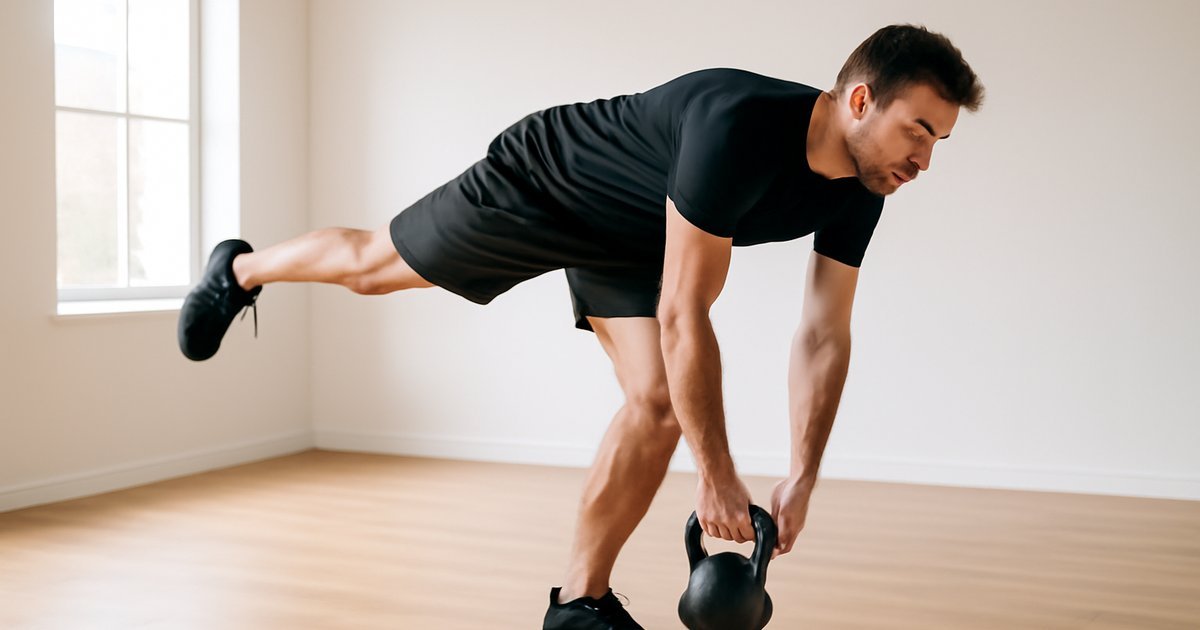
- Hip hinge: Romanian deadlifts, single-leg deadlifts, kettlebell swings. Critical for back health and posterior chain strength.
- Push: Push-ups, dumbbell presses, overhead pressing. Mirrors daily pushing and reaching movements.
- Pull: Resistance band rows, dumbbell rows, pull-ups or inverted rows. Counterbalances all that sitting and forward posture.
- Carry: Farmer’s carries, suitcase carries (one-sided), overhead carries. One of the most functional movements and most neglected.
- Rotate and brace: Pallof press, woodchops, dead bugs. Trains core stability in the way your body actually uses it.
Beginner entry point (2-3 days/week): Pick one exercise from each category, do 2-3 sets of 8-12 reps with controlled form. Focus on quality over load. Rest 60-90 seconds between sets. A full session can be done in 30-35 minutes.
Intermediate (3-4 days/week): Add load progressively, introduce single-leg and single-arm variations, include balance challenges (performing exercises on one leg, using unstable surfaces like a folded yoga mat). Begin combining patterns — like a deadlift into an overhead press.
Advanced (4-5 days/week): Periodize your training with strength phases (heavier loads, 4-6 reps) and endurance phases (lighter loads, higher reps). Add complex movements like Turkish get-ups, barbell clean and press, or loaded carries over longer distances. Consider working with an ACSM-certified personal trainer to optimize programming.
If you’re building your home training setup, our Home Workout Plans guide offers complementary programming that fits well with a functional approach.
Common Mistakes That Sabotage Functional Training Results
Functional fitness is simple in concept but easy to undermine in practice. These are the most common pitfalls — and they’re all fixable.
1. Skipping the basics to jump to “cool” exercises. Turkish get-ups and single-leg kettlebell deadlifts look impressive on social media, but if your basic squat pattern is broken — heels rising, knees caving, lower back rounding — you’ll just be doing a broken pattern under more load. Master the fundamentals first. Results vary based on your movement baseline, so a movement screen with a certified professional can save you months of frustration.
2. Treating every session like a conditioning circuit. Functional training ≠ high-intensity circuit training. Many people turn every session into a breathless, sweat-drenched AMRAP because it feels productive. But true functional strength requires adequate rest between sets and intentional tension — not speed. The ACSM recommends rest intervals of 60-120 seconds for strength-focused sessions.
3. Ignoring the posterior chain entirely. Most people naturally gravitate toward pushing movements and quad-dominant exercises. The result is a dramatic imbalance where the front of the body is overworked and the back of the body — glutes, hamstrings, mid-back, rear deltoids — is undertrained. This is one of the leading contributors to chronic lower back pain. Every push needs a corresponding pull; every squat needs a corresponding hinge.
4. Neglecting recovery. Functional training, especially when it includes heavy carries and compound lifts, is taxing on the central nervous system and connective tissue. Attempting to train functionally 6-7 days a week without adequate rest leads to overuse injuries — the opposite of the goal. Build in at least 2 recovery days per week, and don’t underestimate the role of sleep. Reviewing our sleep hygiene guide can help you optimize the recovery side of the equation.
5. Forgetting that nutrition supports the training. You can’t out-train chronic undereating. Functional movements are metabolically demanding, and your muscles need adequate protein to repair and adapt. According to the Academy of Nutrition and Dietetics, most active adults should aim for 1.2–1.7 grams of protein per kilogram of body weight per day. For more specifics, our protein intake guide breaks it all down clearly.
What to Eat to Support Functional Fitness
Functional training makes real physical demands on your body, and your nutrition strategy should support both performance and recovery.
Prioritize protein at every meal: Lean proteins like chicken breast, eggs, Greek yogurt, cottage cheese, salmon, and legumes provide the amino acids needed for muscle repair. Aim for 20-40 grams of protein per meal, distributed evenly throughout the day — research published in the Journal of Nutrition consistently shows that spreading protein intake across meals is more effective for muscle protein synthesis than front- or back-loading.
Don’t fear carbohydrates: Complex carbohydrates — oats, sweet potatoes, brown rice, quinoa, whole grain bread — fuel your working muscles before training and replenish glycogen afterward. The USDA Dietary Guidelines recommend that 45-65% of total calories come from carbohydrates for active individuals. The downside of very low-carb approaches for functional athletes is impaired high-intensity performance and slower recovery between sessions.
Hydration is functional too: Even mild dehydration (as little as 2% loss of body water) measurably impairs physical performance and neuromuscular coordination, according to the ACSM. Aim for at least 8-10 cups of water daily, with an additional 16-24 ounces for each hour of training.
Anti-inflammatory eating supports joint health: Fatty fish (salmon, sardines), olive oil, berries, leafy greens, turmeric, and ginger all have documented anti-inflammatory properties that support joint and connective tissue recovery — exactly the structures that functional training loads most.
How Long Until You See Results — and What to Track
One of the most honest things to say about functional fitness results is that the first changes you notice won’t be in the mirror. They’ll be in your life.
Weeks 1-3: Neuromuscular adaptation. Your nervous system is learning to recruit muscle fibers more efficiently. You may not feel “stronger” yet, but your coordination and balance will begin improving. Beginners often report feeling more stable and less fatigued by everyday tasks within the first two weeks.
Weeks 4-8: Strength and endurance improvements become measurable. You’ll likely notice you can do more reps with the same load, recover faster between sets, and handle daily physical tasks with noticeably less effort.
Months 3-6: Visible body composition changes alongside significant performance improvements. Research from the NIH suggests that 8-12 weeks of consistent resistance training is the minimum threshold for meaningful muscular hypertrophy.
What to track:
- Movement quality (can you squat to parallel without your heels rising?)
- Reps and loads over time (progressive overload is the core driver of adaptation)
- Daily energy and fatigue levels
- How specific daily tasks feel (stairs, carrying, bending, reaching)
- Joint comfort — functional training should reduce, not increase, chronic discomfort
When to seek professional guidance: If you experience persistent joint pain (not muscle soreness) during or after sessions, if progress stalls completely after 6-8 weeks of consistent effort, or if you have pre-existing injuries that limit your movement, consulting with an ACSM-certified personal trainer or a physical therapist is genuinely worthwhile.
Frequently Asked Questions
Is functional fitness good for weight loss?
Functional training can support weight management by building lean muscle mass, which increases resting caloric expenditure over time, and by burning significant calories during sessions — particularly circuit-style functional workouts. However, nutrition remains the primary driver of fat loss. This approach works best when combined with a sustainable eating strategy.
Can I do functional fitness if I have lower back pain?
Many people with chronic lower back pain actually benefit from functional training, particularly when it addresses core stability and hip strength deficits that are often at the root of the problem. That said, you should work with a physical therapist or certified trainer first to identify safe starting points. Some movements may need to be modified or progressed gradually.
How is functional fitness different from CrossFit?
CrossFit incorporates many functional movement patterns but is typically performed at high intensity in a competitive group setting. Functional fitness as a training philosophy is broader — it emphasizes movement quality and real-world application and doesn’t require high intensity or competitive elements. Many functional training approaches are slower, more deliberate, and well-suited to people who aren’t interested in high-intensity formats.
Do I need equipment to train functionally?
Not at all. Bodyweight movements like squats, push-ups, lunges, single-leg hip hinges, and plank variations cover most functional patterns effectively. A resistance band and a set of dumbbells or kettlebells will expand your options significantly, but they’re not required, especially for beginners.
How does functional fitness change as I get older?
For adults in their 40s, 50s, and 60s, functional fitness becomes even more important. The NIH reports that adults lose 3-8% of muscle mass per decade after age 30 — a process called sarcopenia — and that decline accelerates after 60. Functional training is one of the most effective evidence-based strategies for preserving muscle, balance, and mobility as you age, directly reducing fall risk and supporting independence.
The Bottom Line
Functional fitness isn’t a complicated philosophy or an elite training secret. It’s simply training your body to do what it was designed to do — move well across a full range of human activities, not just perform well on a narrow set of gym exercises.
You don’t need a perfect program, expensive equipment, or hours in the gym each week. You need consistency, progressive challenge, and movements that actually transfer to your life. Start with the foundational patterns, focus on quality over quantity, and give your body the time it needs to adapt.
Pick one movement pattern from today’s guide and practice it this week. That’s your next step. Small, repeated actions build real-world strength that lasts — and that’s the kind of fitness that actually makes life better.
Wellness Disclaimer: This article is for informational and educational purposes only. The content is not intended to replace professional medical, nutritional, or fitness advice. Always consult a qualified healthcare provider, registered dietitian, or certified fitness professional before starting a new health program or making significant changes to your lifestyle.
Content reviewed by our wellness editorial team, with references to peer-reviewed research and guidelines from leading health organizations.