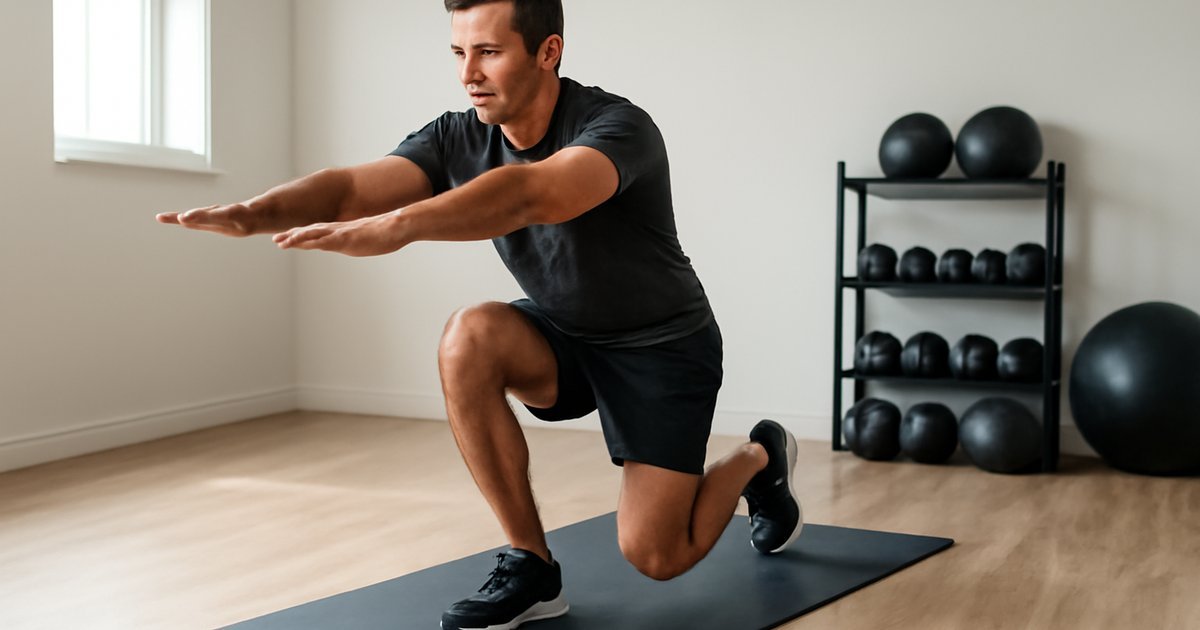
Balance Training: Build Stability and Move Better at Any Age
Most people never think about their balance — until the day they almost fall reaching for something on a high shelf.
Here is a number worth pausing on: according to the Centers for Disease Control and Prevention, falls are the leading cause of injury among adults over 65 — but the physical decline that makes falls more likely begins quietly in your 30s and 40s. By the time most people notice their stability slipping, years of preventable deterioration have already happened.
Balance training is one of the most underrated categories in fitness. While gym culture obsesses over how much you can lift or how fast you can run, the ability to control your body in space — to stabilize, adjust, and move with precision — quietly determines your quality of life more than almost any other physical skill.
The good news: balance is highly trainable at any age, and you do not need special equipment or hours of weekly practice to make meaningful progress. This guide breaks down exactly why balance training matters, how it works in your body, and how to start building it today — whether you are a complete beginner or already active and looking to fill a critical gap in your routine.
Why Balance Training Matters More Than You Think
Balance is not just a “senior fitness” concern. It is a foundational physical skill that affects every movement you make — from carrying groceries up the stairs to pivoting quickly during a recreational soccer game to simply standing on a moving subway without grabbing the rail.
Research published in the British Journal of Sports Medicine found that the inability to stand on one leg for at least 10 seconds in midlife was associated with a nearly doubled risk of all-cause mortality over the following decade. That finding made headlines — and rightfully so. It suggests that balance capacity is not just about coordination; it reflects broader neuromuscular health, cardiovascular function, and even cognitive resilience.
Beyond longevity markers, poor balance has very immediate consequences. It increases your risk of ankle sprains, knee injuries, and lower back pain during everyday activities. It also limits athletic performance: runners with poor single-leg stability tend to develop overuse injuries faster, and lifters with weak proprioception often compensate with problematic movement patterns that eventually cause joint stress.
The American College of Sports Medicine (ACSM) recommends incorporating neuromotor exercises — which include balance, coordination, and agility training — at least two to three days per week for adults. Yet this category is consistently skipped in most self-designed fitness programs.
How Balance Actually Works in Your Body
Understanding balance means understanding three systems that your body integrates constantly without your awareness: your visual system, your vestibular system (the inner ear), and your proprioceptive system (nerve receptors in your muscles, joints, and tendons).
Your proprioceptive system is particularly relevant to training. These sensory receptors detect changes in body position and muscle tension, sending real-time data to your brain so it can make micro-adjustments to keep you upright and stable. When you are sedentary or move in predictable, limited patterns — like sitting at a desk for eight hours — these receptors get less stimulation, and their signaling becomes slower and less precise.
A common myth is that balance is mostly a core strength issue. While a strong core certainly helps, research from the Journal of Strength and Conditioning Research shows that balance deficits are often driven by poor ankle stability, weak hip abductors, and slow neuromuscular reaction time — not just weak abdominals. This is why targeted balance training produces results that generic core work simply cannot replicate.
Another misconception: that balance declines are inevitable with age. Proprioceptive ability does decrease naturally over time, but studies consistently show that this decline is dramatically slowed — and in many cases partially reversed — with consistent balance-specific training. Your nervous system retains significant plasticity well into your 60s and beyond.
How to Get Started: A Practical Balance Training Plan
Balance training does not require a fancy gym setup. Most of the most effective drills use only your bodyweight, a sturdy chair for support when needed, and a small amount of floor space. Here is how to approach it by level:
Beginner (Weeks 1-4): Build the Foundation
- Single-leg stand: Stand near a wall or chair. Lift one foot slightly off the floor and hold for 10-20 seconds. Switch sides. Do 3 sets per side. Progress by closing your eyes once this feels stable.
- Heel-to-toe walk (tandem walk): Walk in a straight line placing one foot directly in front of the other, heel touching toe. Do 10-15 steps forward and backward.
- Weight shifts: Stand with feet hip-width apart. Slowly shift your weight fully onto your right foot, hold for 3 seconds, then shift left. Repeat 10 times each side.
- Sit-to-stand without hands: From a chair, stand up and sit down slowly without using your arms. This builds functional lower-body stability. Aim for 10 slow reps.
Intermediate (Weeks 5-10): Add Instability and Movement
- Single-leg deadlift (bodyweight): Hinge forward at the hips while lifting one leg behind you, keeping your back flat. Return to standing. Do 8-10 reps per side.
- Lateral band walks: With a resistance band around your ankles, step sideways for 10-15 steps in each direction. This targets hip abductors critical for lateral stability.
- Balance board or BOSU ball stands: Perform single-leg stands or squats on an unstable surface. Start with two legs on the BOSU before progressing to one.
- Stability ball exercises: Wall squats with a stability ball, or seated core work on a ball, force constant balance adjustments.
Advanced (Weeks 10+): Dynamic and Multi-Planar Challenges
- Single-leg squat (pistol squat progressions): These require full lower-body strength plus exceptional balance and ankle mobility.
- Plyometric landing drills: Jump from two feet and land on one, holding the landing position for 3 seconds before releasing. This trains reactive stability.
- Agility ladder drills: Lateral and diagonal footwork patterns train fast, multi-directional balance adjustments.
Training frequency: Two to three sessions per week is sufficient for most adults. Each session can be as short as 10-15 minutes when added to an existing workout, or up to 30 minutes as a standalone session.
Common Mistakes That Sabotage Your Progress
Balance training sounds simple — and that simplicity is what causes people to do it incorrectly or inconsistently. Here are the most common errors and how to correct them:
1. Rushing through holds to "finish" faster
Balance training requires sustained neurological engagement. When you rush a single-leg hold to get it done, you bypass the proprioceptive challenge that makes the drill effective. Slow down deliberately. A 20-second controlled hold is far more valuable than a 5-second wobbly one.
2. Only training balance in one plane of motion
Most beginners do all their balance work in the sagittal plane — front to back. But real-life balance demands lateral (side-to-side) and rotational stability too. Include lateral step-ups, cross-body reaches, and rotational drills to build three-dimensional stability.
3. Skipping it when "real" workouts are scheduled
Because balance training does not produce visible muscle or significant caloric burn, it gets deprioritized. But this is exactly the training gap that leads to injury during those "real" workouts. Even 10 minutes of balance work at the end of a strength or cardio session compounds significantly over months.
4. Using too much support too soon
Holding a wall or chair is appropriate for beginners, but many people never progress past it. Challenge yourself to reduce support gradually — fingertips only, then no contact — so your neuromuscular system actually has to work.
5. Ignoring footwear and surface
Doing balance drills in thick, cushioned shoes reduces sensory feedback to your feet and ankles. Whenever safe, train barefoot or in minimal footwear to maximize proprioceptive input. This is one of the fastest ways to accelerate progress.
Supporting Balance with the Right Nutrition and Lifestyle Habits
Balance training is a neuromuscular activity — and your nervous system needs specific nutritional support to function at its best.
Magnesium: This mineral plays a key role in nerve signal transmission and muscle function. The NIH notes that many US adults fall short of the recommended 310-420 mg per day. Food sources include dark leafy greens, almonds, pumpkin seeds, and black beans.
Vitamin D: Research published in the Journal of the American Geriatrics Society has linked low vitamin D levels to impaired neuromuscular function and increased fall risk. The USDA Dietary Guidelines recommend 600-800 IU daily, though many adults — especially those in northern climates or with limited sun exposure — may need more. A healthcare provider can assess your levels.
Protein: Muscle tissue supports joint stability, and adequate protein intake preserves the muscle mass that your balance depends on. The Academy of Nutrition and Dietetics recommends 0.8 grams per kilogram of body weight as a minimum for sedentary adults, with active adults benefiting from 1.2 to 1.6 grams per kilogram.
Hydration: Even mild dehydration impairs proprioceptive sensitivity and reaction time, according to research from the Journal of Athletic Training. Aim for at least half your body weight in ounces of water daily as a general baseline, adjusting for sweat and activity level.
Sleep is equally critical. During deep sleep stages, your brain consolidates motor learning — including the neuromuscular patterns you are training during balance work. Poor sleep does not just leave you tired; it actively slows the adaptation process.
You may also want to explore complementary training modalities that naturally include balance challenges. Kettlebell training requires dynamic stability with every swing and press, while suspension training forces constant trunk and joint stabilization due to the instability of the straps. Both make excellent complements to dedicated balance work.
How Long Until You See Results — and What to Track
Balance improvements follow a predictable timeline, though individual results vary based on your starting point, age, and training consistency.
Weeks 1-2: Neurological adaptation begins. You may notice you feel more coordinated on exercises you have been doing, even if single-leg holds still feel wobbly. This early improvement is largely about your nervous system learning, not muscular change.
Weeks 3-6: Single-leg hold time typically improves noticeably. Many people who started at 5-8 seconds reach 20-30 seconds by week six with consistent practice.
Weeks 8-12: Functional carry-over becomes apparent. People often report feeling steadier on stairs, more confident during hiking or recreational sports, and less prone to ankle rolls during casual movement.
Metrics worth tracking:
- Single-leg hold time (eyes open and closed) — test and record monthly
- Number of balance corrections per set (aim for fewer over time)
- Confidence on unstable surfaces (subjective, but meaningful)
- Frequency of minor stumbles or near-misses in daily life
If you are not seeing improvement after 8-10 weeks of consistent training, consider consulting a physical therapist. Some balance deficits are linked to vestibular disorders, peripheral neuropathy, or hip and ankle dysfunction that benefit from clinical evaluation and personalized programming. Also consider complementing your training with low-impact cardio like rowing machine workouts, which build lower-body endurance that supports stability.
Frequently Asked Questions
Can balance training help with lower back pain?
In many cases, yes. Poor lumbar-pelvic stability is a common contributor to chronic low back pain, and balance training strengthens the deep stabilizing muscles of the spine and hips. Research from the Journal of Physical Therapy Science found that balance and proprioception training significantly reduced pain and disability in adults with nonspecific low back pain. That said, results vary, and if your back pain is severe or radiating, see a healthcare provider first.
Is balance training safe if I have knee or ankle problems?
Generally, yes — and it is often specifically recommended as part of rehabilitation for these joints. Improved proprioception around the knee and ankle reduces compensatory stress and can speed recovery. However, beginners with joint issues should start with very low-challenge drills using support and progress slowly. Working with a physical therapist to design an appropriate program is strongly advised in this case.
How is balance training different from core training?
They overlap but are not the same. Core training focuses on strengthening the muscles of your trunk. Balance training targets the entire neuromuscular system — including your feet, ankles, hips, and visual-vestibular integration. You can have a strong core and still have poor balance, particularly in lateral or dynamic scenarios. Both are valuable and work best together.
Do I need a balance board or BOSU ball to see results?
Not at all. Research shows that bodyweight balance drills on flat surfaces produce significant gains, especially for beginners and intermediate trainees. Unstable surfaces add challenge for advanced users but are not necessary for meaningful progress. Save the equipment investment until you have mastered stable-surface fundamentals.
How do I fit balance training into a busy schedule?
The most effective approach for busy adults is to attach balance drills to existing habits. Do single-leg stands while brushing your teeth. Add heel-to-toe walks during a phone call. Spend the first 10 minutes of any strength session on balance work before lifting. Small, consistent doses accumulate faster than you expect.
Start Small, Stay Consistent, Move Better
Balance training will not give you the adrenaline rush of a heavy lifting session or the endorphin flood of a long run. What it will give you — quietly, consistently, over weeks and months — is something more foundational: the ability to move through your life with control, confidence, and resilience.
Start with one drill today. A 20-second single-leg stand while you wait for your coffee to brew. A slow, deliberate tandem walk down your hallway. It sounds small because it is — and that is exactly the point. The smallest consistent action is infinitely more powerful than the perfect program you never start.
Your balance is a skill. Train it like one.
This article is for informational and educational purposes only. The content is not intended to replace professional medical, nutritional, or fitness advice. Always consult a qualified healthcare provider, registered dietitian, or certified fitness professional before starting a new health program or making significant changes to your lifestyle.
Content reviewed by our wellness editorial team, with references to peer-reviewed research and guidelines from leading health organizations.